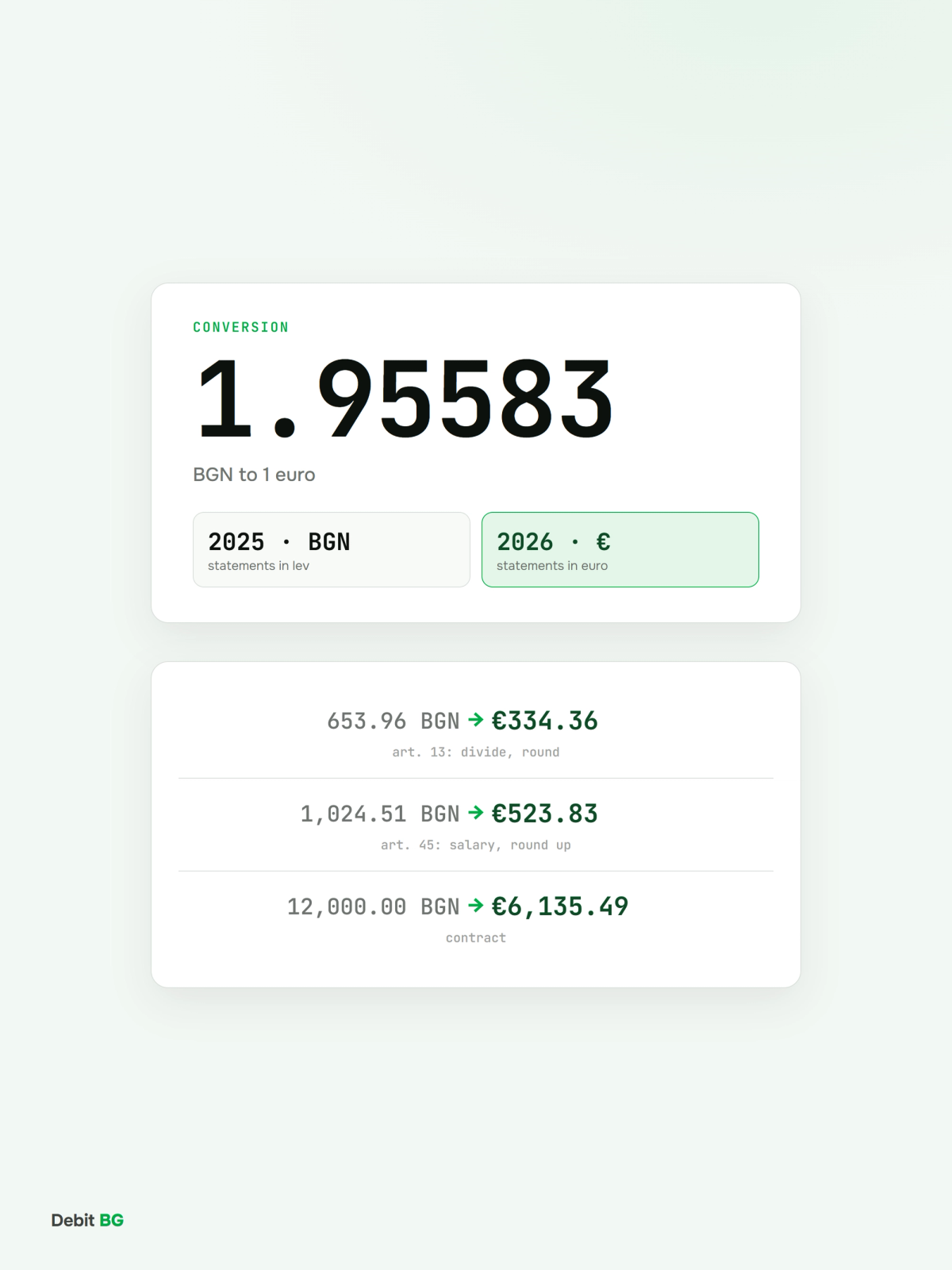
Since 1 January 2026 the euro has been Bulgaria's national currency and the only reporting currency for bookkeeping. The fixed rate is 1.95583 Bulgarian lev (BGN) to 1 euro. For accounting firms, 2026 is the first year they will close entirely in euro: the 2026 annual financial statements are prepared in euro, and the 2025 comparatives have to be restated. This article pulls together the rules of the Euro Introduction Act (ЗВЕРБ) and the Ministry of Finance clarifications, and turns them into concrete requirements for accounting software.
Current as of 13 November 2026. This article is for information and is not tax advice.
Short answer
Accounting software for 2026 in Bulgaria must: record every entry in euro from 1 January 2026; keep 2025 and earlier data in lev; convert by dividing by 1.95583 and rounding to two decimals; show conversion differences at the level of each sub-account; produce 2026 financial statements in euro with restated 2025 comparatives; and file VAT returns in euro only.
Key dates at a glance
- 8 July 2025: the EU Council approves Bulgaria's adoption of the euro.
- 8 August 2025: dual display of prices in lev and euro begins.
- 1 January 2026: the euro becomes the reporting currency. Closing lev balances are converted and become opening balances in euro.
- 1 to 31 January 2026: lev and euro cash circulate side by side.
- 8 August 2026 inclusive: mandatory dual price display ends.
- 31 December 2026: the first year-end closed entirely in euro.
How to convert correctly
The law sets the method, not the software. The lev amount is divided by the full rate of 1.95583 and the result is rounded to two decimals using standard rounding (art. 13 of the Act). If the third decimal is 5 or more, the second goes up by one.
Example: 653.96 BGN / 1.95583 = 334.364... → €334.36.
A common mistake in spreadsheets and older programs is multiplying by a rounded factor such as 0.51129. Across large amounts and many lines this creates cent differences that later fail to reconcile. Good software divides by the full rate, rounds each line separately and does not allow a manually entered factor.
The payroll exception. Accrued but unpaid salaries are rounded up to the next euro cent if the third decimal is above zero (art. 45). The Ministry of Finance adds that this is done separately for each employee, not for the payroll as a whole. Example: 1,024.51 BGN → €523.83.
Opening balances and conversion differences
On 1 January 2026 closing lev balances are converted to euro separately for each asset and liability (art. 48). The Ministry of Finance adds three practical points:
- Conversion runs from the lowest analytical level up to the control account: each receivable, each payable, each invoice.
- Differences from converting assets and liabilities go to current financial income or expense. Differences on equity go to retained earnings or accumulated losses.
- If the software cannot convert at sub-account level, a special account such as "Differences from the euro changeover" may be used, as long as the differences are fully traceable and the account is properly closed.
What to check before year-end: does your program have a report showing the conversion difference for every sub-account, and has the temporary account been closed if you used one? Auditors will ask exactly this.
VAT, invoices and credit notes
- VAT returns filed after 1 January 2026 are filed in euro only.
- Lev invoices dated up to 31.12.2025 whose input VAT is claimed in 2026 are entered in the VAT ledgers in euro at the official rate.
- Debit and credit notes issued from 1 January 2026 are in euro, even when they correct a lev invoice.
- A 2025 document received after 1 January 2026 is booked in the period it relates to. If the document is in euro, the amount is converted back to lev at the official rate while the 2025 statements are not yet adopted.
- Utility bills for December 2025 issued in January 2026 are in euro. The expense is recognised in 2025 in lev, and the invoice enters the 2026 VAT ledgers in euro.
This is where software has to do something that sounds simple but is not: know which period a document belongs to, not just when it arrived, and carry one document in two currencies without booking it twice.
Cash and the dual circulation month
From 1 January 2026 fiscal devices register and report payments to the National Revenue Agency (NRA) in euro only. During January 2026 the lev cash balance was tracked analytically in lev while control accounts were in euro. The Ministry of Finance requires a primary document, such as a bank deposit slip, to support converting a lev cash balance.
The 2026 annual financial statements
The 2025 statements are prepared in lev. Statements with a reporting date after 1 January 2026, meaning the 2026 statements, are prepared and published in euro. In them:
- the 2025 comparatives are restated in euro;
- the notes disclose the reason for the change in presentation currency.
In practice the software must produce a balance sheet and income statement with two euro columns, one of which comes from lev data. If you have been building the comparative column by hand in Excel, now is the time to check whether your program can do it.
Checklist: 8 questions for your accounting software
- Does it divide by the full 1.95583 rate and round each line separately?
- Does it show conversion differences per sub-account?
- Does it keep an archive of the original lev data for 2025 and earlier?
- Does it know which period a document belongs to, not just when it was entered?
- Does it file the VAT ledgers and returns in euro?
- Does it round unpaid salaries up, separately for each employee?
- Does it produce the 2026 statements in euro with restated 2025 comparatives?
- Does it match euro bank payments to 2025 lev invoices without manual adjustments?
How Debit BG helps
Debit BG is a complete accounting solution for accounting firms and their clients. Documents are read with AI OCR and posted to the right accounts, and bank transactions arrive automatically through licensed open banking infrastructure that covers all major banks in Bulgaria. Every document keeps its original and a full audit trail, so conversion differences and documents that straddle the two periods can be traced back to their source. If you work with MicroInvest, the data goes there in one click.
The next big change after the euro is digital reporting: SAF-T and mandatory e-invoicing from 2028.
Close 2026 without Excel
Debit BG reads your clients' documents with AI, receives bank transactions automatically and keeps their books in one system, with a full audit trail.
Book a demo →Frequently asked questions
What currency are Bulgarian 2026 financial statements in?
Euro. Any annual financial statements with a reporting date after 1 January 2026 are prepared in euro, and the 2025 comparatives are restated in euro at 1.95583. The 2025 statements stay in lev.
How do you convert lev to euro for accounting in Bulgaria?
Divide the lev amount by 1.95583 and round the result to two decimals (art. 13 of the Euro Introduction Act). Do not multiply by a rounded factor such as 0.51129. For example, 653.96 BGN becomes €334.36.
Where do differences from converting opening balances go?
Differences from converting assets and liabilities are recognised as current financial income or expense. Differences on equity go to retained earnings or accumulated losses (art. 48 of the Act).
Can a 2026 Bulgarian VAT return be filed in lev?
No. VAT returns filed after 1 January 2026 are in euro only. Lev invoices from 2025 whose input VAT is claimed in 2026 are entered in euro at the official rate.
How are salaries rounded in the euro conversion?
Accrued but unpaid salaries are rounded up to the next euro cent if the third decimal is above zero (art. 45 of the Act). Rounding is done separately for each employee.
What currency is a credit note for a 2025 invoice issued in?
Euro. From 1 January 2026 debit and credit notes are issued in euro, even when they relate to an invoice issued in lev.
Sources
- Act on the Introduction of the Euro in the Republic of Bulgaria (ЗВЕРБ), State Gazette No. 70 of 2024, as amended: art. 12, 13, 20, 45 and 48
- Ministry of Finance: 10 clarifications on the euro (KIK Info, 28.11.2025, in Bulgarian)
- Euro introduction in Bulgaria: a practical guide for accountants (KIK Info, in Bulgarian)
- Bulgaria's official euro website