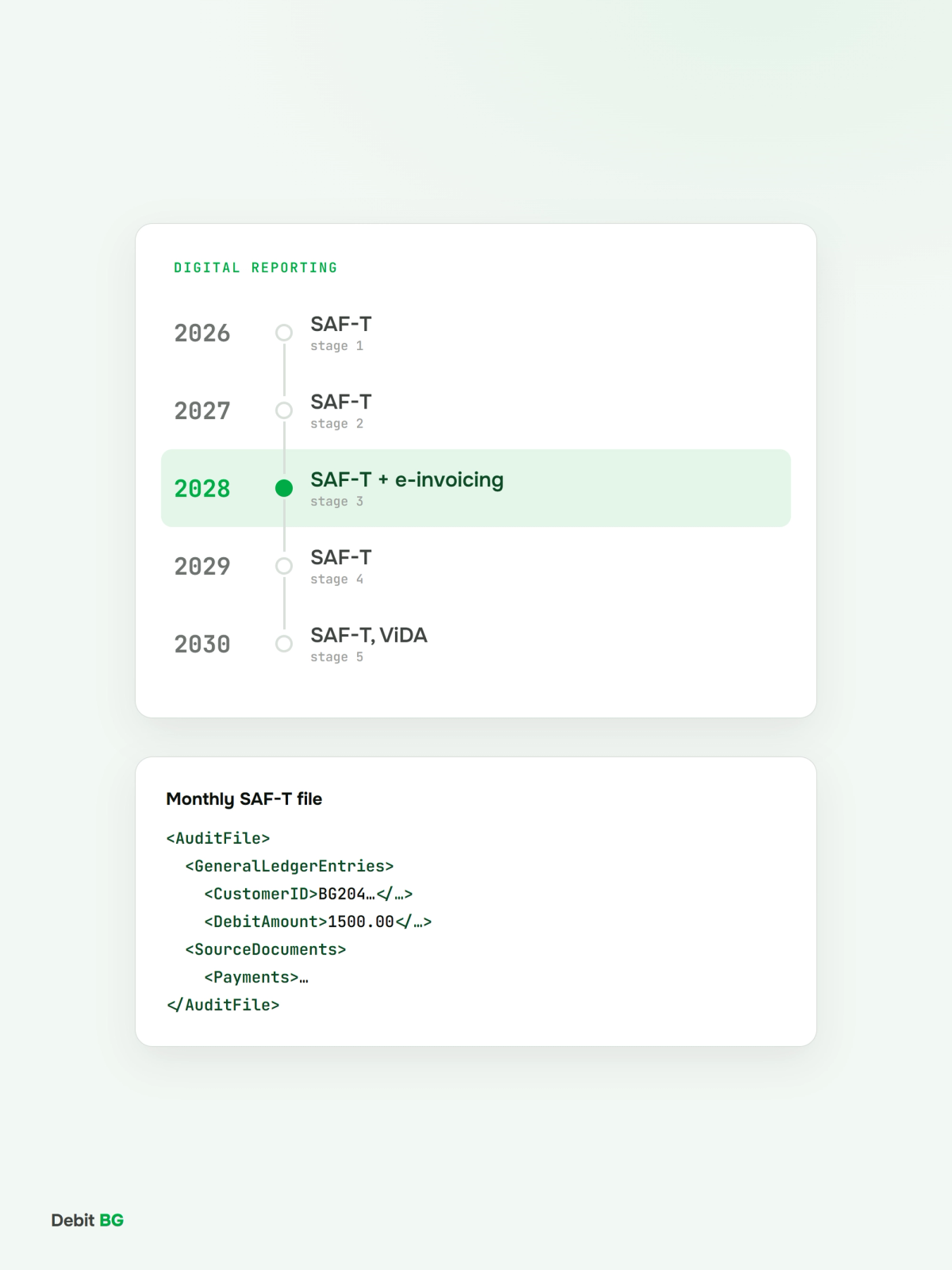
Bulgaria is moving to digital tax reporting on two fronts at once. SAF-T (Standard Audit File for Tax) has been mandatory for the largest companies since 1 January 2026 and will cover almost every VAT-registered business by 2030. In parallel, on 4 November 2026 the Council of Ministers approved VAT Act amendments that introduce mandatory structured e-invoicing for domestic supplies from 1 January 2028. Both changes point the same way: bookkeeping built on manual data entry and Excel will not hold up.
Current as of 13 November 2026. The VAT Act amendments have not yet been finally adopted by Parliament and details may change. This article is for information and is not tax advice.
Short answer
SAF-T requires a company to file a standardised XML file with the National Revenue Agency (NRA) containing its journal entries, invoices, payments and fixed assets. The obligation is phased in over 5 stages from 2026 to 2030. E-invoicing, proposed from 2028, requires every invoice between businesses in Bulgaria to be a structured electronic document reported to the NRA in real time. Accounting software has to keep clean structured data from the moment of entry: company and VAT numbers, chart of accounts, bank accounts, and goods and service codes.
What is SAF-T
SAF-T is an OECD standard for exchanging accounting data with tax authorities. Instead of separate reports, the company files one structured file that shows the NRA the full path of a transaction: invoice, journal entry, payment. The Bulgarian version has three file types:
- Monthly file: journal entries in chronological order, purchase and sales invoices, and payments. Filed every month by the deadline set in the NRA executive director's order.
- Annual file: fixed asset balances and movements. Filed by 30 June of the following year, together with the annual corporate tax return.
- On-demand file: inventory balances and movements, when the NRA requests it during an inspection or audit.
Who files SAF-T in Bulgaria, and from when
- 1 January 2026: large companies with net sales over BGN 300 million or taxes and social contributions over BGN 3.5 million for 2023. According to the NRA's reminder letters, about 470 companies.
- 1 January 2027: companies that meet the same thresholds based on 2024 data.
- 1 January 2028: companies with net sales over BGN 15 million or taxes and contributions over BGN 1.5 million for 2025.
- 1 January 2029: all remaining large, medium and small companies under the Accounting Act.
- 1 January 2030: all remaining obligated entities, mainly VAT-registered micro-companies.
Micro-companies that are not VAT-registered, non-profits without commercial activity and budget organisations are out of scope.
What this means for an accounting firm: most of your clients fall into stages 4 and 5. That buys time, but not much. The data that will go into their first SAF-T file is being entered now. A chart of accounts not mapped to the NRA's SAF-T nomenclatures, counterparties without a company number or with a wrong VAT number, and payments not linked to invoices will all become problems on the day the file has to pass validation.
Mandatory e-invoicing from 2028
The draft VAT Act amendments were published for public consultation in September 2026 and approved by the Council of Ministers on 4 November 2026. Under the approved draft:
- From 1 January 2028 invoices and notes for supplies taking place in Bulgaria, between VAT-registered suppliers and recipients established in the country, are issued as structured electronic documents. Advance payments and supplies to state and municipal bodies are also covered.
- Intra-community supplies stay out of scope.
- Data is reported to the NRA in real time. After the consultation, the original centralised model was replaced by a decentralised model built on interoperability between systems.
- The recipient loses the right to deduct input VAT if the supplier was required to issue a structured e-invoice and did not.
- The consultation draft also adds new mandatory invoice fields: the Combined Nomenclature code for goods or the service classification code, and the supplier's bank account.
The same bill raises the mandatory VAT registration threshold: to €60,000 in 2027, €70,000 in 2028 and €75,000 in 2029.
Why 2028 and not 2030
At EU level, the VAT in the Digital Age package (ViDA, Council Directive (EU) 2025/516) lets member states mandate domestic e-invoicing without a special derogation, and from 1 July 2030 it introduces real-time digital reporting for intra-EU supplies. Bulgaria is choosing to introduce domestic e-invoicing two years earlier.
What accounting software must be able to do
- Keep structured data from the start. A PDF or photo of an invoice is not enough. You need extracted fields: supplier, company number, VAT number, lines, tax base, VAT, bank account.
- Validate counterparties. Company and VAT numbers must be valid, or the file and the e-invoice will be rejected.
- Link invoice, journal entry and payment. SAF-T shows the full path of a transaction. A payment not linked to an invoice is a mismatch the NRA can see.
- Have complete bank data. Bank statements uploaded by hand once a month leave gaps. An automatic feed from the bank through open banking gives a complete picture for every day.
- Map the chart of accounts to the NRA's SAF-T nomenclatures for every company you serve.
- Export SAF-T XML and validate it before filing.
- Issue and receive structured e-invoices and report them to the NRA in real time once the rules take effect.
- Keep an audit trail: who changed what, and when, on every document.
How Debit BG helps
Debit BG is a complete accounting solution built around structured data. Client documents are read with AI OCR into individual fields, not a pile of text. Bank transactions arrive automatically through licensed open banking infrastructure that covers all major banks in Bulgaria, and are matched to invoices. Every change stays in the audit trail. That is the same foundation both SAF-T and e-invoicing rest on: correct data, entered once, at the source.
Before SAF-T, though, comes something closer: the first year-end in euro.
Get your clients ready for SAF-T
Debit BG reads documents with AI into individual fields, receives bank transactions automatically and matches them to invoices. Clean data, entered once.
Book a demo →Frequently asked questions
When did SAF-T become mandatory in Bulgaria?
On 1 January 2026, for the largest companies, about 470 of them. The obligation expands in stages every 1 January until 2030, when it also covers VAT-registered micro-companies.
Which companies file SAF-T in Bulgaria in 2027?
From 1 January 2027, companies that meet the stage 1 thresholds (net sales over BGN 300 million or taxes and contributions over BGN 3.5 million) based on 2024 data. The next big expansion is on 1 January 2028, with a threshold of BGN 15 million in net sales.
What does the monthly SAF-T file contain?
Journal entries in chronological order, purchase and sales invoices, and payments for the month. Fixed assets are filed in an annual file, and inventory only on request from the NRA.
Is e-invoicing mandatory in Bulgaria?
Not as of November 2026. Public contracting authorities must accept electronic invoices, but between businesses they are voluntary. On 4 November 2026 the Council of Ministers approved VAT Act amendments that make structured e-invoices mandatory for domestic supplies from 1 January 2028. Parliament still has to adopt the law.
Is a PDF invoice sent by email an e-invoice?
Not for the purposes of the new regime. The proposed rules require a structured electronic document that systems can read automatically and that is reported to the NRA. A PDF is an image of the document, not structured data.
What happens if a supplier does not issue a structured e-invoice?
Under the approved draft, the recipient loses the right to deduct input VAT when the supplier was required to issue a structured e-invoice and did not.
Sources
- EY Bulgaria: draft amendments to the VAT Act, e-invoicing and new VAT reporting (15.10.2026, in Bulgarian)
- Government approves new VAT threshold and e-invoices from 2028 (04.11.2026, in Bulgarian)
- NRA reminds 470 large taxpayers about SAF-T by letter (KIK Info, in Bulgarian)
- European Commission: VAT in the Digital Age (ViDA)
- Council Directive (EU) 2025/516